Culture Collision: Native Peoples and Europeans
by Eric F. Rangel
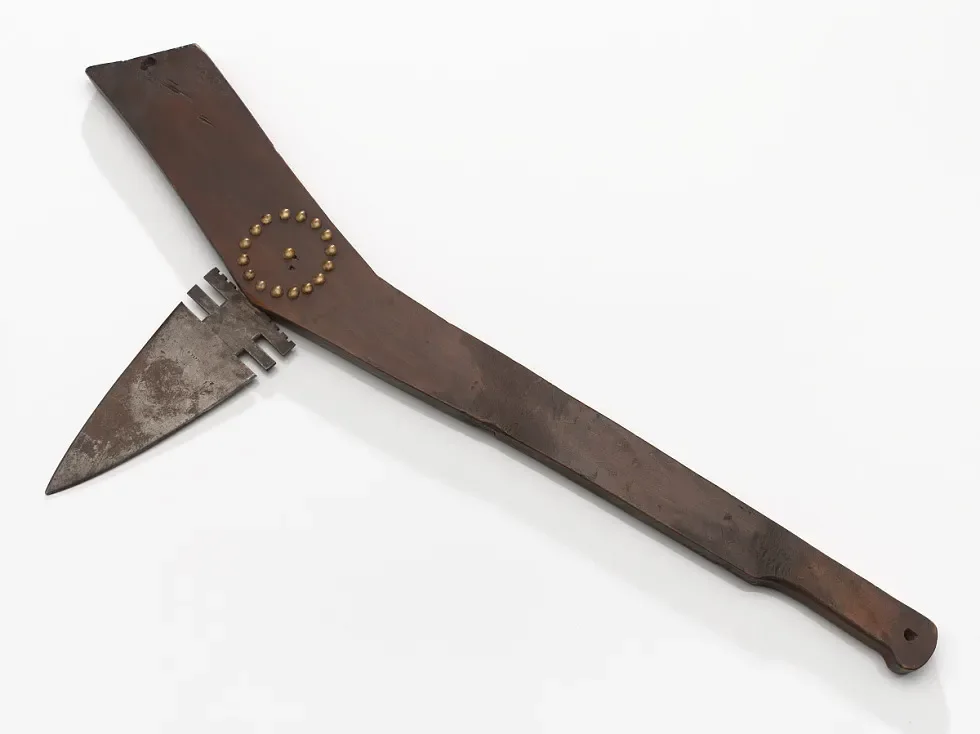
Photo Credits/Source: National Museum of the American Indian
In examining the cultural collisions between Native peoples and Europeans, few artifacts better reflect the tension, adaptation, and creativity of this encounter than the Gunstock Club. Named for its resemblance to the wooden stock of a musket or rifle, the Gunstock Club emerged as both a weapon of war and a symbol of cultural resilience in the 18th and 19th centuries.
Used by various Native groups across North America, including the Lakota, also known as the Teton Sioux, these clubs varied in form. Heavier, broader designs were common in the Northern Plains, while slimmer versions appeared further east among Midwestern tribes. Their shapes were intentional. Native craftsmen mirrored the form of European firearms not as imitation, but as a powerful reinterpretation.
European influence went beyond form. Over time, many Gunstock Clubs incorporated metal blades and spikes, materials acquired through trade with settlers and colonizers. Without this cultural exchange, such a hybrid weapon might not have existed. Yet it is important to note that Native peoples did not passively absorb European influence. Instead, they transformed it, adapting foreign materials and ideas into meaningful and functional tools rooted in their own traditions.
The Gunstock Club became more than a battlefield weapon. It was a symbol of resistance, adaptation, and identity. In some communities, it took on ceremonial significance and was carried by leaders and high-ranking warriors as a mark of status. Decorated clubs signified power and spiritual meaning, further illustrating the complex layers of Indigenous response to colonization.
In researching this weapon, several questions came to mind. How did access to European metalworking tools influence Native craftsmanship? Did other Indigenous groups interpret or use the Gunstock Club differently? These questions point to the richness of Indigenous innovation and the depth of cultural exchange that occurred during this period.
Artifacts like the Gunstock Club challenge us to rethink simplistic narratives of cultural domination. They show us how Native peoples creatively navigated the violent pressures of colonization, preserving their identities, honoring their traditions, and asserting their agency through art, warfare, and adaptation.
Sources
Busatta, Sandra. “Three Warclubs: The Ball-Headed, Gunstock, and Sword Clubs in the Beltrami Collection.” Antrocom: Online Journal of Anthropology, vol. 19, no. 2, 2023.
“Gunstock Club | National Museum of the American Indian.” Si.edu, 2025, https://americanindian.si.edu/collections-search/object/NMAI_177099. Accessed 22 May 2025.
“Oceania.” Ox.ac.uk, 2025, https://web.prm.ox.ac.uk/weapons/index.php/tour-by-region/oceania/americas/arms-and-armour-americas-44/index.html. Accessed 22 May 2025.